
If you’re new to affiliate marketing, one of the most important early decisions you’ll make is this:
Should you focus on organic traffic or paid ads?
Both models can generate revenue. Both can support legitimate businesses. But they differ significantly in cost structure, risk profile, skill requirements, and time horizon — especially for beginners.
This article breaks down those differences using available industry data and practical experience so you can make a decision based on evidence, not hype.
Understanding traffic is a key part of learning affiliate marketing — start with my Affiliate Marketing for Beginners guide if you haven’t yet.
What Is Organic Traffic?
Organic traffic refers to visitors who find your content naturally through unpaid channels such as:
- Search engines (Google, Bing)
- YouTube search
- Social media discovery
- Email subscribers built over time
In affiliate marketing, organic traffic is most often generated through:
- SEO-focused blog posts
- Long-form educational content
- YouTube videos
- Evergreen tutorials
- Consistent publishing over time
Why Organic Traffic Matters
According to industry studies from firms like BrightEdge and HubSpot, organic search commonly drives over 50% of website traffic across industries, making it the single largest digital channel for many content-driven businesses.
Additionally:
- SEO leads have been shown to convert at higher rates than outbound marketing leads in multiple B2B studies.
- Evergreen content can continue generating traffic months or even years after publication.
- High-ranking content compounds over time as domain authority improves.
That said, organic traffic typically requires:
- 3–6+ months to gain measurable traction for new websites
- Ongoing content creation
- Keyword research and search intent analysis
- Patience and consistency
It is slow to start — but durable once established.
What Are Paid Ads?
Paid ads involve purchasing traffic through platforms such as:
- Google Ads
- Meta (Facebook & Instagram) Ads
- TikTok Ads
- YouTube Ads
You pay per click (CPC), per thousand impressions (CPM), or per conversion.
For beginners considering funnels and paid strategies, check out WA vs ClickFunnels for a detailed comparison.
The Financial Reality
Average costs vary widely by industry, but benchmarks often show:
- Google Search Ads average CPC: commonly $1–$4+, with competitive industries exceeding $10+ per click.
- Facebook Ads average CPC often ranges between $0.50–$2.00 depending on targeting and competition.
- Conversion rates for cold paid traffic frequently range between 1–3% for beginner campaigns.
That means a beginner could easily spend hundreds (or thousands) of dollars before achieving a positive return on ad spend (ROAS) — especially while learning.
Paid traffic delivers speed — but it introduces financial risk.
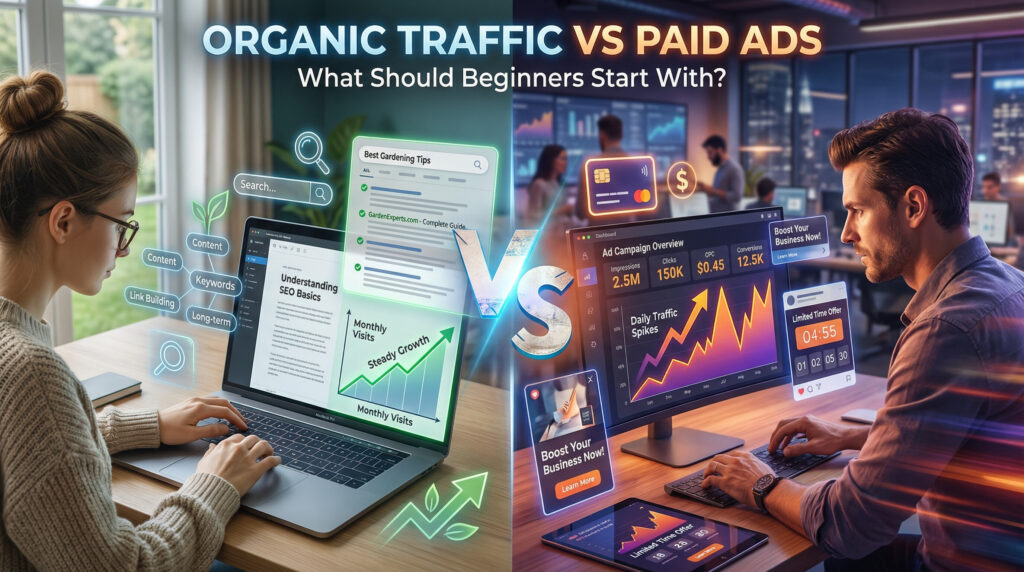
The Core Tradeoff: Time vs. Money
At a structural level, the difference looks like this:
| Organic Traffic | Paid Ads |
|---|---|
| Costs time upfront | Costs money upfront |
| Slower to start | Faster to test |
| Compounds over time | Stops immediately when ads stop |
| Lower financial risk | Higher financial risk |
| Builds long-term assets | Builds short-term traffic flow |
For beginners with limited budgets, this distinction is not theoretical — it’s practical.
Risk Profile for Beginners
Organic Traffic Risk
- A blog post that doesn’t rank costs time, not ad spend.
- Content can be updated and improved.
- Traffic can grow gradually as domain authority increases.
There is opportunity cost — but not direct financial loss.
Paid Ads Risk
- Poor targeting can drain a budget quickly.
- Inexperienced funnel setup reduces conversion rates.
- Testing requires sufficient capital to reach statistically meaningful data.
Industry data suggests many new advertisers struggle to achieve profitable ROAS early without proper tracking, funnel optimization, and audience refinement.
For someone brand new to digital marketing, this learning curve can be expensive.
Skill Development Differences
From an E-E-A-T (Experience, Expertise, Authoritativeness, Trustworthiness) perspective, the path you choose shapes your long-term business credibility.
Organic Marketing Builds:
- Search intent understanding
- Content creation discipline
- Topic authority
- Audience trust
- Long-term brand positioning
Google’s Helpful Content guidance emphasizes content written for users, not algorithms. Building organic traffic forces you to align with that principle.
Paid Advertising Builds:
- Data analysis
- A/B testing methodology
- Funnel design
- Conversion optimization
- Budget management
These are valuable skills, but they are typically more effective after you understand your audience and messaging.
Speed vs. Stability
Paid ads can produce traffic within hours.
Organic content often takes months to rank — particularly in competitive niches.
But speed does not equal sustainability.
If you stop paying for ads, traffic drops to zero immediately.
If you stop publishing content, existing high-performing articles can continue attracting visitors passively.
In many documented case studies within SEO communities, single well-ranking articles have generated traffic consistently for 12–36 months with only minor updates.
This durability is what makes organic traffic an asset rather than an expense.
Which Is Better for Beginners?
Based on:
- Industry cost benchmarks
- Conversion rate averages
- Risk exposure
- Skill development sequence
Organic traffic is generally the lower-risk starting point for beginners.
That does not mean paid ads are ineffective. It means they require:
- Clear niche positioning
- Proven offer-market fit
- Conversion tracking infrastructure
- Budget allocated specifically for testing
Without those components, paid advertising becomes speculation rather than strategy.
When Paid Ads Make Sense
Paid ads are often appropriate if:
- You already have validated offers converting organically
- You understand your audience’s pain points clearly
- You have email capture systems and follow-up sequences in place
- You can afford to test without financial strain
In this scenario, ads become an amplifier — not a gamble.
A Practical Beginner Path
For someone starting from zero, a structured progression often looks like this:
- Learn affiliate marketing fundamentals.
- Choose a focused niche.
- Publish consistent, search-optimized content.
- Analyze which topics generate clicks and conversions.
- Build an email list.
- Optimize conversion paths.
- Then experiment with paid traffic strategically.
This sequence reduces risk while building competence.
A Note on Expectations
Organic traffic is not “free.”
It requires:
- Research
- Writing or video production
- Technical SEO basics
- Consistency over months
Paid ads are not “instant success.”
They require:
- Capital
- Testing
- Funnel optimization
- Emotional resilience during losses
Both models require effort. Neither is passive at the beginning.
Final Thoughts
Organic traffic and paid ads are tools — not identities.
For most beginners:
- Organic traffic offers lower financial risk.
- It builds transferable skills.
- It creates durable digital assets.
- It aligns well with long-term E-E-A-T principles by emphasizing value-first content.
Paid ads can later accelerate growth once your messaging, positioning, and offer are validated.
Start steady.
Build foundations.
Scale when the data supports it.
If you’re currently evaluating structured affiliate training programs that emphasize organic traffic foundations, researching platforms thoroughly and reviewing independent case studies can help you make an informed decision.
The goal isn’t speed alone.
It’s sustainability.
If you want to focus on organic traffic and structured training, see my Wealthy Affiliate review.
About the Author
Randy Hartman is the founder of Wealthy Endeavor, where he shares evidence-based strategies for building a real affiliate marketing business. After testing multiple platforms, tools, and content strategies, he focuses on helping beginners avoid common mistakes and build sustainable online income through SEO and content marketing.
His approach emphasizes realistic expectations, consistent effort, and long-term growth — not hype or “get rich quick” tactics.
? Start here: Beginner’s Guide to Affiliate Marketing (Step-by-Step for 2026)