
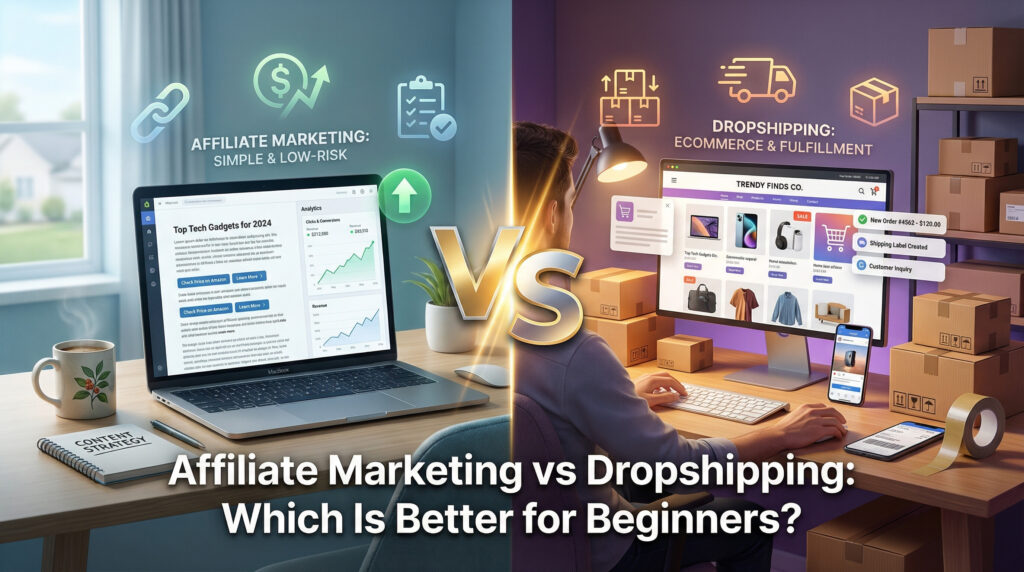
If you’re looking to start an online business, you’ve probably narrowed it down to two popular options:
Affiliate marketing or dropshipping.
Both promise flexibility. Both are beginner-friendly on the surface. Both are often marketed as low-cost ways to make money online.
But they are not the same business model.
And for beginners, the differences matter a lot.
Let’s break this down honestly so you can decide which path makes more sense for you.
If you’re new, start with my Beginner’s Guide to Affiliate Marketing (Step-by-Step for 2026) to understand how affiliate marketing really works.
What Is Affiliate Marketing?
Affiliate marketing is a business model where you promote other companies’ products and earn a commission when someone buys through your referral link.
You don’t:
- Create the product
- Handle customer service
- Manage inventory
- Process refunds
Your job is to:
- Build content
- Attract traffic
- Recommend helpful products
It’s often built around blogging, YouTube, niche websites, or email marketing.
The barrier to entry is relatively low — especially if you’re willing to learn and build gradually.
What Is Dropshipping?
Dropshipping is an e-commerce model where you create an online store and sell products that are shipped directly from a supplier.
You don’t hold inventory — but you are responsible for:
- Running the store
- Handling customer service
- Managing returns
- Processing payments
- Dealing with supplier issues
Most dropshipping businesses rely heavily on paid advertising to generate traffic quickly.
While it can scale fast, it can also burn money fast.
Startup Costs: Which Is Cheaper?
Affiliate Marketing
- Website hosting
- Domain name
- Optional tools
- Time investment
You can start lean and grow slowly.
Dropshipping
- E-commerce platform subscription
- Paid ads (often required)
- Store design tools
- Apps and integrations
While technically possible to start dropshipping cheaply, most beginners end up spending money on ads before seeing results.
For someone testing the waters, affiliate marketing usually carries less financial risk.
Risk Level for Beginners
This is where the real difference shows up.
With affiliate marketing:
- Your biggest investment is time.
- If a piece of content doesn’t perform, you learn and improve.
- You don’t deal with customers directly.
If you’re wondering who this platform is designed for, see Who Is Wealthy Affiliate For?.
With dropshipping:
- You are responsible for customer satisfaction.
- Shipping delays can damage your reputation.
- Ad campaigns can lose money quickly.
- Refunds come out of your pocket.
For beginners without e-commerce experience, dropshipping can feel overwhelming fast.
Traffic Strategy Differences
Affiliate marketing often focuses on:
- Organic search (SEO)
- Content marketing
- Long-term traffic building
Dropshipping often focuses on:
- Paid advertising
- Social media ads
- Rapid testing of products
Organic traffic builds more slowly but becomes more stable over time.
Paid ads can generate results quickly — but they require skill, testing, and budget.
If you’re new to marketing, learning organic traffic first is often safer and more sustainable.
If you’re comparing platforms, see my WA vs ClickFunnels article for side-by-side differences.
Skill Development
Affiliate marketing teaches:
- Niche research
- Content creation
- Search engine optimization
- Audience trust building
Dropshipping teaches:
- Product sourcing
- Ad management
- Conversion optimization
- Customer service systems
Both require learning.
But affiliate marketing tends to build foundational online business skills that transfer more broadly.
Long-Term Sustainability
Affiliate marketing businesses can become:
- Authority sites
- Passive income assets
- Brand platforms
- Content hubs
Dropshipping stores often depend on:
- Trend-based products
- Continuous ad spend
- Fast product cycles
That doesn’t mean dropshipping can’t work long-term — but it typically requires more active management.
Affiliate marketing is generally more stable once traffic is established.
Which Is Better for Beginners?
If you:
- Want lower financial risk
- Prefer building gradually
- Don’t want to handle customers
- Are willing to create content
- Think long-term
Affiliate marketing is usually the better starting point.
If you:
- Are comfortable running paid ads
- Enjoy fast-paced testing
- Don’t mind handling customer issues
- Want faster (but riskier) potential scaling
Dropshipping may suit you.
The Honest Take
Both models can work.
Both models require effort.
Neither is passive in the beginning.
But for most beginners starting from zero experience, affiliate marketing is:
- Simpler
- Lower risk
- Easier to learn
- More sustainable
It allows you to build skills and confidence without risking large amounts of money upfront.
If you’re new and want a structured way to learn how affiliate marketing actually works, I break down the full process in my Affiliate Marketing for Beginners guide.
And if you’re evaluating platforms that teach this model step-by-step, you can read my complete Wealthy Affiliate review for a detailed breakdown of how it compares.
Final Thoughts
Choosing between affiliate marketing and dropshipping isn’t about which one is “better.”
It’s about which one fits:
- Your personality
- Your risk tolerance
- Your budget
- Your learning style
Start simple.
Build skills.
Then scale intelligently.
About the Author
Randy Hartman is the founder of Wealthy Endeavor, where he breaks down affiliate marketing into clear, actionable steps for beginners. His content focuses on real strategies, transparency, and building sustainable online income.